

9:30 AM - 5:30 PM IST
Master Class on The Pursuit of π & the Advent of Calculus in India
SPEAKERS
Register
Location
Auditorium, Vishwa Bharti Public School, Arun Vihar, Sector 28
Noida,
Uttar Pradesh
201301,
India
Contact
INDICA & CENTRAL SANSKRIT UNIVERSITY
present
MASTER CLASS ON THE PURSUIT OF π & THE ADVENT OF CALCULUS IN INDIA
A two-day immersion into the mathematical traditions that shaped the advent of calculus in India
INDICA, in collaboration with Central Sanskrit University, announces a two-day in-person Master Class on The Pursuit of π & the Advent of Calculus in India with Prof. K. Ramasubramanian.
This offering continues the academic collaboration between INDICA and Central Sanskrit University, which has brought together a distinguished series of intensive Master Classes exploring diverse dimensions of the Indian Knowledge Systems. Earlier programmes in this series have examined the Mahābhārata as a civilisational text with Prof. Vishwa Adluri, introduced the classical methodology of śāstric reasoning through Tantrayukti with Prof. M. Jayaraman, explored the Indian understanding of the mind through Bhāratīya Mānasa Śāstra with Prof. Mala Kapadia, examined the Āgamic foundations of temple institutions through Temple Management in the Āgamas with Dr. Deepa Duraiswamy, presented an introduction to the Yogasūtras with Nrithya Jagannathan and contemporary relevance of Dharmaśāstra through the Master Class on Dharmaśāstra with Nithin Sridhar.
How did Indian mathematicians think about the infinite? How did they approach approximation, error, convergence, trigonometric series, and the mysterious number π? How did profound mathematical ideas come to be expressed in Sanskrit sūtras, verses and prose commentaries without modern mathematical symbols and equations?
This two-day Master Class by Prof. K. Ramasubramanian is anchored in his recently published book The Pursuit of π & the Advent of Calculus in India. The program introduces participants to the remarkable story of how Indian mathematicians, especially those of the Kerala school, developed sophisticated mathematical ideas connected with π, infinite series, interpolation, summation, convergence, and the conceptual foundations of calculus.
The book presents π not merely as a numerical constant, but as a powerful lens through which we can understand the evolution of Indian mathematical thought. It brings together Sanskrit verses, its mathematical interpretations, geometrical constructions, numerical methods, and an accurate narrative of the extraordinary contributions of the Kerala school, especially Mādhava of Saṅgamagrāma, without hyperbolic claims.
This Master Class is designed for a public audience with an interest in mathematics, Sanskrit, Indian Knowledge Systems, history of science, and the intellectual traditions of Bhārata. Participants are not expected to know advanced calculus. A good familiarity with mathematics at the secondary and higher secondary level will be sufficient. Sanskrit knowledge is welcome but not mandatory; key terms and verses will be explained in an accessible manner.
Rather than making broad claims about priority, the Master Class will help participants understand how Indian mathematicians actually reasoned, computed, expressed, transmitted, and refined mathematical ideas. It will introduce the conceptual journey from geometry and trigonometry to summation, limits, infinite series, and also address the larger question: what constitutes calculus?
Purpose of the Master Class
This Master Class aims to:
- Introduce the history of π as a gateway into the development of calculus in India
- Present Sanskrit mathematical verses and commentaries in an accessible manner
- Trace the evolution of ideas such as zero, infinity, summation, approximation, convergence, and infinite series
- Highlight the contributions of Āryabhaṭa, Brahmagupta, Bhāskara, Mādhava, Nīlakaṇṭha Somayājī, and Jyeṣṭhadeva
- Help participants appreciate the originality, and the beauty of expressing mathematical ideas in verses without loss of rigor.
- The pedagogical significance of looking into the Indian mathematical texts even at the current times.
- Offer a balanced and evidence-based response to the question: “Did Indians invent calculus?”
Who Should Attend?
This Master Class is suitable for:
- Undergraduate and postgraduate students of mathematics, physics, astronomy, Sanskrit, engineering, and Indian Knowledge Systems
- Researchers and serious readers interested in Indian mathematics
- Sanskrit and śāstra enthusiasts interested in the mathematical knowledge tradition of Bhārata
- Teachers and educators of mathematics, history of science, and IKS
- General participants curious about π, Mādhava, the Kerala school, and the history of calculus
Mandatory Text
All selected participants are required to procure a copy of The Elusive Ratio and the Advent of Calculus in India by Prof. K. Ramasubramanian, available at https://garudalife.in/the-elusive-ratio-and-the-advent-of-calculus-in-india. Please use the coupon code ELSVCAL20 at the time of purchase to avail of a 20% discount. The Master Class will be anchored in this text. Select verses, examples, diagrams, and mathematical explanations from the book will be discussed during the sessions.
Gratitude-Based Participation
At INDICA, learning is anchored in gratitude, not transaction. This Master Class is offered in reverence to the knowledge we have inherited and to those who choose to engage with it sincerely. We follow a Gratitude Model of participation, which invites engagement rooted in intention, not obligation.
There is no fixed upfront fee for participation. Each program, however, involves significant intellectual, organisational, and financial commitment. The approximate cost per participant for this tw0-day Master Class is ₹3500.
At the conclusion of the Master Class, participants who feel enriched by the experience may choose to offer Guru Dakṣiṇā as an expression of gratitude for the learning received and in support of INDICA’s efforts to continue curating such initiatives in Indian Knowledge Systems. Participants are invited to offer Guru Dakṣiṇā in a manner that reflects the value they derive from the experience and their appreciation for the space being created. Details regarding the same will be shared with all participants after the Master Class.
Gratitude may also be expressed through action. Carrying forward what is received through writing, mentoring, dialogue, or other forms of service is equally valued.
Participation and Selection
Participation is through application and selection. A focused cohort will be curated to enable serious engagement and meaningful discussion.
Applicants should apply only if they can attend the complete two-day Master Class and fulfil the mandatory reading requirement. Applications will be reviewed, and selected participants will receive a formal confirmation.
Travel and Accommodation
Participants are requested to make their own travel and accommodation arrangements. INDICA does not provide or coordinate either.
Meals and Refreshments
Tea will be served twice each day, and lunch will be provided on both days.
Certificate of Participation
A Certificate of Participation will be awarded to participants who complete the Master Class in its entirety. This includes attending all sessions across all two days in full and on time, and fulfilling all completion requirements of the program, including submission of feedback and any additional components such as a reflective essay or other assigned work, where applicable.
Schedule
Day 01 — Saturday, 19 December 2026
Session 1 | 10:00 – 11:15 The Elusive Ratio: π as a Gateway to Calculus
- Why were Indians interested in evaluating π?
- Did Indian mathematicians realize that the ratio was elusive?
- Clever ways of handling the challenges of approximation
- The book’s central theme: from simple geometry to sophisticated analytic ideas
Tea Break | 11:15 – 11:30
Session 2 | 11:30 – 12:45 Mathematics in Sanskrit: Poetry, Precision, and Transmission
- Why Indian mathematicians expressed formulae in verse
- Sūtra, kārikā, and commentary as modes of knowledge transmission
- Key technical Sanskrit terms, compact expressions, and interpretive challenges
- Śūnya, khahara, large numbers, small quantities, and the Indian comfort with abstraction
Lunch | 12:45 – 13:45
Session 3 | 13:45 – 15:00 Foundational Nyāyas: Geometry, Proportion, and Trigonometry
- Bhuja-koṭi-karṇa-nyāya and right-triangle reasoning
- Trairāśika-nyāya and the rule of three
- Jyā, koṭi-jyā, śara, cāpa: Indian trigonometric vocabulary
- Chord, arc, sine relations, and their role in astronomical computation
Tea Break | 15:00 – 15:15
Session 4 | 15:15 – 16:30 Pursuit of π: The Polygon-Doubling Approach
- Early approximations of π across civilizations
- Āryabhaṭa’s value of π and the meaning of āsanna
- Polygon-doubling method: distinction between different traditions
- The beautiful recursive relation
Optional Interaction | 16:30 – 16:45
Day 02 — Sunday, 20 December 2026
Session 5 | 10:00 – 11:15 From Sums to Limits: Interpolation, Series, and Approximation
- Summation of natural numbers, squares, cubes, and geometric series
- Sine tables and interpolation techniques in Indian astronomy
- From finite procedures to infinite processes
- Limit-like reasoning in the Indian mathematical tradition
Tea Break | 11:15 – 11:30
Session 6 | 11:30 – 12:45 Mādhava’s Infinite Series for π
- The geometric setting behind Mādhava’s π series
- Arc length, infinitesimal segments, and summation
- The series for π and its mathematical significance
- Mādhava’s approach and the later ones by Gregory–Leibniz
Lunch | 12:45 – 13:45
Session 7 | 13:45 – 15:00 Antya-saṃskāra: Error Correction and Fast Convergence
- Why Mādhava’s original π series converges slowly
- Antya-saṃskāra as a technique to enhance convergence
- Sthaulya, truncation error, and numerical refinement
- Brilliant fast convergent approximations given by Kerala mathematicians
Tea Break | 15:00 – 15:15
Session 8 | 15:15 – 16:30 The Question of Calculus in India
- Function-like reasoning and rates of change
- Observations of Bapudeva Sastri and the response to it
- Derivatives, infinite series, and the conceptual ingredients of calculus
- Did Indians invent calculus? A balanced historical and mathematical assessment
Concluding Interaction | 16:30 – 16:45
Note to Participants
This Master Class is rigorous yet accessible. It is meant for serious learners who wish to understand the mathematical, linguistic, and civilizational significance of Indian contributions to calculus. Participants are encouraged to come with curiosity, openness, and a willingness to engage with both Sanskrit sources and mathematical ideas.
Speakers
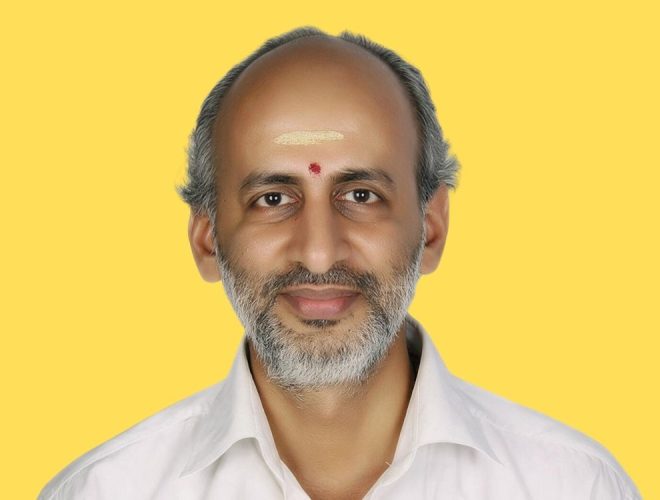
Prof. K. Ramasubramanian
Prof. K. Ramasubramanian is Professor-in-Charge, Centre for Traditional Indian Knowledge and Skills (CTIKS), Indian Institute of Technology, Bombay. A world-class scholar of great repute with a unique combination of expertise in sciences, Sanskrit, and spirituality. As a historian of Indian mathematics and astronomy, a Sanskrit scholar, a Vedic teacher, and a philosopher, his unparalleled multi-disciplinary scholarship and popular teachings have inspired thousands of students and teachers to preserve and revive India’s knowledge heritage.