समत्वम्- Equanimity In Bhagavad-Gita

The world is at unrest and unease. As we may observe to begin with, there is no peace, purity and balance in the world order. The struggle for dominance over another is more acutely manifested. There is new struggle to protect oneself from the insecurity from the other.

If we observe the life of animals, the carnivorous animals have only one job to do, is to find the food, but for herbivorous animals there are two jobs to do – protect oneself from the carnivorous animals and find one’s food. But when it comes to the human beings, there are three jobs to do. First is to protect oneself from others, find whatever is necessary for living or survive and the most important is to protect oneself from oneself. But to protect oneself from oneself is a really task in the life, because from the childhood we have hurt ourselves knowingly or unknowingly. So, it is very important to learn to be calm and composed to handle or face any situation without being affected by internal or external desired or undesired situations. For which we need to have equilibrium of the mind.

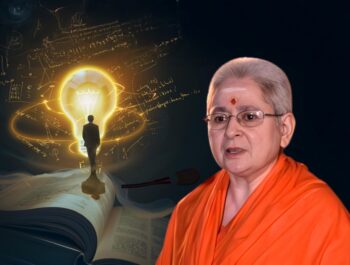
In this talk, Swamini Sadvidyananda ji will explore ‘Samatvam’- the Hindu unique concept of equilibrium as enunciated in Bhagavad Gita.

Tesla As A Metaphor For Dhyana Yoga | Modern Insights On Meditation

This talk begins with a simple observation: highly capable people often struggle with meditation, while others find that the mind turns inward with relative ease—even after long breaks. Reflecting on this contrast led Sundar back to his early exposure to contemplative practice, and eventually to a contemporary analogy that occurred to him while charging his Tesla. The autonomous nature of Dhyāna, where attention begins to move inward on its own, struck him as closely resembling a self-driving system that no longer requires constant manual control. In the same moment, the idea of “lifetime charging” echoed Grace and the inner goal or direction implanted early on—forces that continue to support the inward movement long after they were first received.

Against this backdrop, the talk explores why meditation is universally difficult, drawing on the Katha Upaniṣad’s insight that the senses are factory-set to face outward. It then takes up a seldom-asked question—even among long-time practitioners: Can meditation be measured? This leads to Sundar’s original A-P-B Framework—Absorption, Peace, and Bliss—and its expression in the Meditation Monitor, developed through collaboration with AI tools such as ChatGPT and Claude. The session concludes with a striking fulfillment of the Tesla metaphor, grounded in Śaṅkarācārya’s commentary on the famous “two birds” mantra of the Muṇḍaka Upaniṣad, where in two short sentences Śaṅkara draws the roadmap for the path of a Dhyāna Yogin.

Devi In Upanishads

In this talk, the Acharya will discuss how Devi is depicted as the ultimate principle in the Upanishads. Further he will will discuss the references to Devi worship in multiple Upanishads, especially in the Shakta Upanishads and key passages within the principal Upanishads such as the Kena, Mundaka, and Shvetashvatara Upanishads. The session will also highlight the importance of Devi Upasana in the pursuit of the Moksha Purushartha.

Adhyasa Bhashya Of Adi Shankaracharya

2-day Residential Contemplative Retreat
Adhyasa Bhashya of Adi Shankaracharya
By
Swami Narasimhananda

The Adhyasa Bhashya of Adi Shankaracharya is the opening commentary to the Brahma Sutras. It stands as one of the most profound explanations in Advaita Vedanta. In a few deep paragraphs, Acharya explains the root of human suffering. This suffering comes from the superimposition of the Self with the non-Self. It also arises from mixing the eternal with the transient. This misidentification leads to bondage. Removing it through thoughtful inquiry brings liberation. The Adhyasa Bhashya is both the foundation and the entrance to the broad structure of Advaita Vedanta.

This retreat is participative and immersive. It invites seekers to study the text not only intellectually but also to deeply internalize its insights through guided discussions, reflective exercises, and meditative practices. Together, we will explore how Shankara’s analysis is still relevant today. It shows us how mistaken identities shape our lives. Freedom comes when the truth of the Self shines through without any barriers.

Date & timings: Starts on Friday, 31st October, 2025 at 5:00 PM and concludes on Sunday, 02nd November, 2025 1:00 PM

Venue: Indica Gurukulam @ Ritambhara, No. 69, BMTC Layout, Adjacent to Kammasandra Village, Lakshmipura Hobli.

The Retreat, located just on the outskirts of Bangalore city, is a small beautiful space dedicated to Yoga & spiritual studies and practices in a simple and clean environment adjacent to a farm of its own.

Retreat Fee: Rs.8000/-

*Avail Early Bird discount offer: Rs.7,000/- for registration before 30th September, 2025. (Limited seats only)

For more details contact us at +91 7760079475 or email: nithin@advaita-academy.org

Accommodation: Shared accommodation will be provided

Food: Simple sattvik food with fresh grown vegetables from the farm

Reaching the Retreat Venue: The venue is about 22 kms from Majestic Bus Stand and is accessible through Magadi Road and Tumkur Road preferably through own vehicles. The retreat center is very close to ‘Kamadhanu Kshetra’  a highly popular Raghavendra Swamy temple in last few years. It would take about an hour to reach the retreat venue from the heart of the city. Participants have to make their own arrangements. If any assistance is required Indica Yoga Team will help.

42nd Symposium on Sri-Harsha’s Khaṇḍanakhaṇḍakhādya

The Khaṇḍana-khaṇḍa-khādya, the magnum opus of 12th-century Advaita philosopher and poet Śrī-Harṣa, stands as a landmark in the history of Indian philosophical thought. Renowned for its incisive reasoning, rigorous dialectics, and refined literary style, the work holds a distinctive place within the Advaita Vedānta tradition as a masterful exercise in philosophical refutation (khaṇḍana). Its very title “A Delicacy Made from Fragments of Refutations” announces its polemical flavour and Śrī-Harṣa’s relish for intellectual debate.

While Śrī-Harṣa is more popularly remembered in literary circles for his Sanskrit epic Naishadhīya-carita (commonly known as Naishadham), a courtly poem of immense poetic sophistication and rich imagery, his Khaṇḍana-khaṇḍa-khādya is a profound contribution to the philosophical literature of Advaita Vedānta. The two works, though seemingly distinct in tone and subject, together offer a window into the complex persona of Śrī-Harṣa as a scholar who was equally at home in the world of refined poetry and uncompromising metaphysical inquiry.

Born to a learned Kanyakubja Brahmana family—Śrīhira and Mamalladevī—Śrī-Harṣa’s early life was steeped in Sanskrit learning. His father, Śrīhira, served as a poet in the court of the Gāhāḍavāla king Vijayachandra. Later, Śrī-Harṣa flourished as both a poet and philosopher under Gāhāḍavāla king Jayachandra. His writing  includes not only Naishadhacharitam and Khaṇḍana-khaṇḍa-khādya, but also a wide range of works such as Vijayapraśastiḥ, Śivāśakti-siddhiḥ, Amarakhaṇḍanam, and Sthairyavicāraṇa-prakaraṇam, among others. These reveal a wide-ranging intellect engaged in both aesthetic and spiritual pursuits.

Although Naishadham is often associated with courtly love and royal grandeur with vivid erotic and aesthetic expressions, several commentators have identified esoteric and mystical layers within the poem. Jain scholar Nayachandra Sūri (15th century) described Śrī-Harṣa as jitendriya (one with mastered senses), while modern Telugu scholar Gunturu Seshendra Sharma, in his book Swarnahamsa, argues that the Naishadham encodes Chintāmaṇi mantra-sādhanā, revealing a deeper metaphysical underpinning beneath its poetic veil. These divergent yet converging interpretations suggest that Śrī-Harṣa was not merely a connoisseur of language and logic, but a man deeply immersed in mantra-upāsanā and Advaitic contemplation.

In the Khaṇḍana-khaṇḍa-khādya, Śrī-Harṣa turns his dialectical acumen toward a systematic dismantling of the epistemological and ontological foundations of the Nyāya-Vaiśeṣika school. Central to Śrī-Harṣa’s philosophical position is the non-dualist insight that ultimate reality (Brahman) is beyond pramāṇas (means of knowledge) and conceptual articulation. Śrī Harṣa critiques the very possibility of establishing valid knowledge through definition (lakṣaṇa), inference (anumāna), or perception (pratyakṣa), arguing that all such constructs are inherently self-limiting. In this, he aligns with and yet extends the apophatic tendencies seen in earlier Advaita works like Gauḍapāda’s Kārikās and Śaṅkara’s Brahmasūtra-bhāṣya.

Throughout this work, Śrī-Harṣa’s aim is to demonstrate the instability of rational inquiry within philosophy. For any argument that a philosopher may offer for his view, there is always an equally persuasive counterargument that undermines its conclusion. Since the deliverances of reason are always vulnerable to rational defeat in this way, they cannot constitute good evidence for any philosophical view.

Unlike the more expository texts within Advaita tradition that seek to establish the non-dual truth through śruti, logic, and anubhava, Śrī-Harṣa’s method is relentlessly apophatic. His work belongs to the tradition of khaṇḍana-granthas—texts that perform philosophical demolition rather than construction—yet it does so with a unique flair. The phonetic flamboyance of the title itself reflects not just a fondness for alliteration, but the self-aware joy of a dialectician who finds aesthetic pleasure in philosophical sparring.

Through this symposium, we aim to explore the methodological, epistemological, and metaphysical dimensions of Khaṇḍana-khaṇḍa-khādya.

SCHEDULE

Time Speaker Title of Talk
9.00 AM-9.10 AM Nithin Sridhar
Director & Chief Curator, INDICA Moksha
Opening Remarks
9.10 AM-10.00 AM Dr. Nagaraj Paturi
Kulapati | Vice-Chancellor, INDICA
Inaugural Talk – Placing Khaṇḍanakhaṇḍakhādya Within Śrīharsha’s Body Of Work
10.00 AM-10.30 AM Acharya Jaishankar Narayanan
Vedanta Acharya. Runs Aarsha Vidya Varshini Gurukulam at Kallidaikurichi
Bheda Khaṇḍanam – Refutation Of Distinctness In Khaṇḍanakhaṇḍakhādya
10.30 AM-11 AM Vidwan Kuvalaya Datta
Traditional Scholar & Teacher of Advaita Vedanta, Datta Peetham, Mysuru
भावत्व-अभावत्वलक्षणयोः खण्डनम् – Refutation Of The Characteristics Of Being And Non-being [Sanskrit Talk]
11.00 AM-11.30 AM Dr. Suryanarayana Jammalamadaka
Senior Project Manager, Siddhanta Knowledge Foundation |
Co-founder, Kameswari Foundation
The Inadequacy Of Definitions In Nyāya
11.30 AM – 12.00 PM Sudhanshu Shekhar
Commissioner of Income-tax in New Delhi
Rejection Of Causation As Per Khaṇḍanakhaṇḍakhādya
12.00 PM – 12.30 PM Vidwan Raghavendra Arolli
Assistant Professor (Guest) in Nyaya Department at Shri Rajiv Gandhi Campus, Central Sanskrit University, Sringeri
प्रत्यक्षलक्षणखण्डनम् – Refutation Of The Definition Of Perception [Sanskrit Talk]
12.30 PM – 1.00 PM Dr. Kuppa Bilwesha Sarma
Assistant Professor, Department of Prachina Vyakarana, Sampurnanand Sanskrit University, Varanasi
अद्वैतसिद्धौ खण्डनयुक्तयः – Application Of Principles From Khaṇḍanakhaṇḍakhādya In Advaita Siddhi [Sanskrit Talk]
1.00 PM – 1.30 PM Vidwan Dr. Ganesh Ishvar Bhat
HOD and Professor in Advaita Vedanta Department, Rashtriya Sanskrit Sansthan in Rajiv Gandhi Campus, Sringeri
अद्वैते प्रमाणविचारः- Inquiry Into The Means Of Knowledge In Advaita [Sanskrit Talk]
1.30 PM – 2.00 PM Vidwan Vachaspati Joshi Shastri
Adhyapaka, Jagadguru Shankaracharya Sankrita Pathashala, Dharwad
खण्डखाद्यग्रन्थे वितंडासंचारः- The Method Of Vitaṇḍā Employed In Khaṇḍanakhaṇḍakhādya [Sanskrit Talk]
2.00 PM – 2.30 PM Dr. Srinivas Jammalamadaka
Director, IKS Research, Brhat Educational Trust | Co-founder, Kameswari Foundation
Śrīharsha’s Refutation Of Opposition Of Existence & Non-existence
2.30 PM – 3.00 PM Nithin Sridhar
Director & Chief Curator, INDICA Moksha
Conclusion And Vote Of Thanks


शिव स्वरोदय विज्ञान : Divine Science Of Breathing

According to Hindu Shastras, the universe is composed of the five great elements (pañca mahābhūtas). By observing and analyzing these elements, one can uncover the hidden laws that govern both the cosmos and human life.

To reveal these secrets, Lord Shiva imparted the Divine Science of Breathing to Devi Parvati. This sacred knowledge is enshrined in the ancient tantric scripture Shiva Swarodaya, also referred to as Phonetic Astrology or Swara Shastra.

Shiva Swarodaya explores the subtle nature of breath (swara) and its profound impact on the body, mind, and consciousness. It is founded on the principle that different modes of breathing correspond to different types of actions—physical, mental, and spiritual.

In this session, we will delve into this magnificent yet lesser-known treasure of Indic knowledge.

An Introduction To Dakshinamurthy Stotram

Adi Shankaracharya has packed tightly the entire Advaita Vedanta Jnana in the Dakshinamurthy Stotram. He presents the Ultimate Absolute Reality ,Para Brahman as being manifest in three forms : 1.Eshwara,2.Guru and 3.Atman or Paramatman simultaneously in the context of a praise of Dakshinamurthy in each of the Slokas of the Stotram.
The Oneness of all these above three is conveyed well.

By being established in the Jnana delivered through the Dakshinamurthy Stotram it is possible to achieve Liberation or Moksha in its full glory and grandeur of Self Realisation of Oneself with the Universe.

In this talk, Prof. CSR Prabhu will give a detailed introduction and an overview of the text.

Jayatu Svaananda: Glory Of Ganapati

The phrase “Jayatu Svaananda,” meaning “Victory to Inner Bliss,” reflects Ganesha’s role in guiding devotees toward spiritual fulfillment and inner peace. This talk will explore the profound mentions of Sri Svananda in the Shruti, Smriti, and Puranas, unveiling the sacred texts that have venerated his form and essence through time. It will delve into the diverse sampradayas of Ganapathi Upasana practiced across a Bharat, showcasing the regional traditions and spiritual lineages that uphold his worship. Additionally, the session will offer an immersive glimpse into the stutis—the devotional hymns and praises—that extol Ganesha’s virtues and blessings. From the playful child to the wise guardian, Ganapati is revered in myriad forms as the deity of auspicious beginnings, the protector of sacred knowledge, and the guardian of ancient tradition, reminding us that true success blossoms not from external conquests, but from the serene light of the awakened soul.

Indriya Nigrahah As A Jnana Sadhana

Indriya-nigrahaḥ is the mastery over the functioning of one’s sense organs. What drives a person’s indriyas are the compelling desires for worldly pleasures. When the indriyas function under the influence of instinctive thoughts, conditioned by fancies or cravings, the inner self—the sanctioning authority—has no real control over them.

True nigraha is the mastery of the buddhi (intellect) over the ways of the indriyas. It is when a person consciously and deliberately exercises choice over the functioning of the sense organs, guided by a well-formed value structure.

Yet, even such disciplined control is not the ultimate solution. Only Self-knowledge (ātma-jñāna) can truly liberate one from the hold of cravings for sense pleasures that shape and condition one’s patterns of thinking.

Thus, Indriya-nigrahaḥ becomes an essential preparatory step in the pursuit of Self-knowledge.

Acharyaa Revathi will shed light on different aspects of Indriya Nigraha.

Sri Shreedhara Swami: Life, Dharma, And Vedantic Insights

The talk explores the life and spiritual legacy of Sri Shreedhara Swami Maharaj, a revered saint regarded as an incarnation of Dattatreya. Inspired by his Guru and the blessings of Samarth Ramdas, he traveled extensively to spread the message of Sanatan Vedic Dharma. The talk examines key events in his life and the philosophical depth of his teachings, highlighting how they illuminate core insights from Advaita Vedanta, DharmaShastra, and the Puranas. It also reflects on the relevance of his message for contemporary seekers.